
Cross-Border Trust in Education Credentials
About Certizen
Certizen is a trusted governance and credentialing operator in Hong Kong, with core competency in digital identity verification and credential lifecycle management. Beyond technology adoption, Certizen brings the capability to verify the identity of issuers, holders, and verifiers within trust ecosystems, which is a critical layer that complements the technical infrastructure. Certizen is positioned to lead the transformation of the regional education credential landscape by enabling a modern, people-centric trust ecosystem where academic records move freely and are verified reliably across national boundaries, extending across the Greater Bay Area, China, and Asia.
In partnership with Affinidi, Certizen sought to validate whether decentralised trust registries, supported by Trust Registry Query Protocol (TRQP) and W3C‑compliant Verifiable Credentials, could create a scalable, cross‑border framework for issuing, storing, and verifying academic credentials.
This initiative was designed to demonstrate both the technical feasibility and governance capacity of such an ecosystem, enabling operators to manage trusted education registries in the region. To further strengthen the authoritative foundation of the trust ecosystem, the Global Trusted Identity Foundation (GTiDF), an independent NGO dedicated to advancing trusted digital identity frameworks, provided governance-oversight and authoritative endorsement throughout the proof of concept.
The Challenge
The education credential landscape across Asia remains deeply fragmented. Each country operates their own trust frameworks and governance systems, making it difficult for employers or institutions to verify credentials issued by foreign universities. Without a unified discovery mechanism, verifiers often lack clarity about whether an issuer is legitimate or authorised, especially when dealing with unfamiliar ecosystems or foreign ministries. This fragmentation amplifies fraud risk: fake universities, spoofed DIDs, and tampered certificates can pass superficial cryptographic checks because verifiers cannot assess whether the issuing entity is recognised within its national trust framework.
At the same time, students face limited mobility due to the absence of portable, interoperable credentials. Applying to institutions or employers abroad requires manual verification steps and often direct coordination between universities, creating delays and operational costs. National education authorities face the challenge of preserving governance flexibility, ensuring that local policies remain fully enforceable while still enabling participation in a global network without dependence on centralised authorities or bilateral integrations.
The Solution
To address these challenges, Certizen and Affinidi collaborated on a multi‑country proof of concept (POC) that demonstrated how TRQP‑enabled trust registries can enable secure, policy‑governed, cross‑network verification of education credentials. At the heart of the solution is a decentralised model: each country’s Ministry of Education operates its own Trust Registry, where universities are registered and digitally authorised to issue specific degrees through verifiable authority statements.
These registries are discoverable by verifiers in other countries, enabling them to determine “who is authorised and for what” without any prior integration or manual lookup. With TRQP, a Singapore employer can query the Hong Kong or Macau registry in real time and receive verifiable, machine-readable confirmation that the issuer is legitimate and recognised under local governance rules.
The POC also demonstrated the complete lifecycle of academic credentials using W3C Verifiable Credentials, Affinidi’s issuance stack, and DIDComm-based presentation protocols. A student receives a university-issued credential through the Affinidi-powered Certizen mobile app, stores it in a secure vault, and shares it seamlessly with a foreign employer through a simple QR interaction.
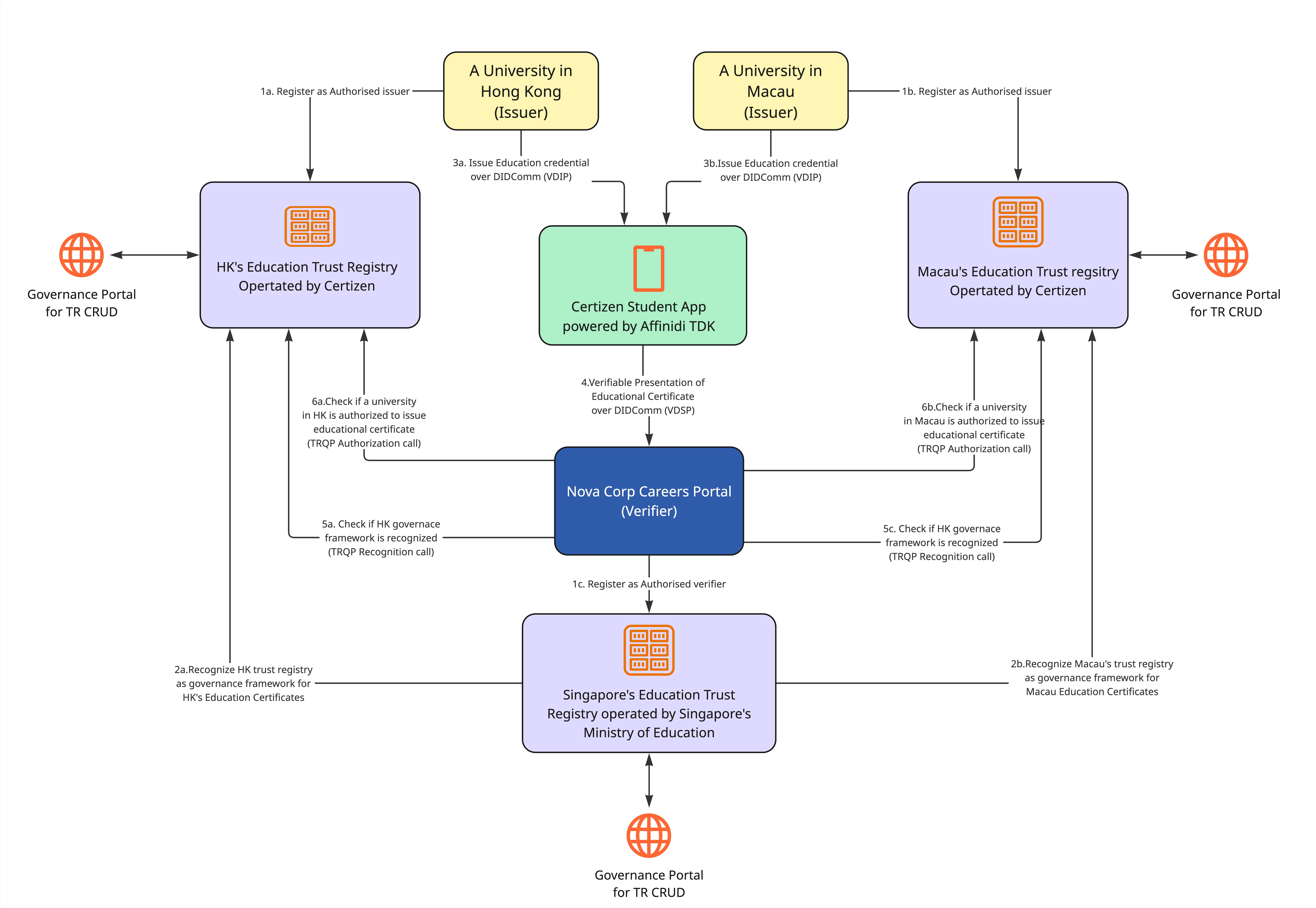
The employer’s verifier portal performs layered trust checks: cryptographic validation of credential integrity, authorisation checks against the issuer’s national registry, and governance verification to ensure the issuer’s registry is recognised by the verifier’s home authority. These checks collectively prevent fraudulent credentials, block unauthorised universities, and ensure that only governance-compliant authority chains are accepted. While Affinidi provided the decentralised infrastructure and standards-compliant issuance stack, Certizen contributed its identity verification expertise and technical protocol to ensure that the personal and institutional trust layer was as robust as the cryptographic one.
This model offers a future-ready foundation where Certizen can act as a governance operator facilitating onboarding of universities, managing registry rules, and supporting end-to-end verification flows.
The Results
The POC successfully showcased a functional cross‑border trust ecosystem involving Trust Registries in Hong Kong, Macau, and Singapore. It demonstrated seamless interoperability: a student credential issued in Hong Kong could be verified by a Singapore employer within minutes, with all authorisation and governance checks executed dynamically through TRQP. This confirmed that decentralised trust registries can eliminate the need for manual verification and bilateral integrations while upholding policy fidelity for each participating country.
Equally important, the system proved resilient against fraud. The POC flagged multiple negative scenarios such as fake issuers, private institutions lacking authorisation, expired authority chains, and tampered credentials. This highlighted the strength of combining cryptographic integrity checks with governance-level validation. These results reinforced that scalable, machine-readable trust checks are essential for modern credential ecosystems.
Critically, Certizen’s identity verification capabilities proved essential in bridging governance rules with real-world participant assurance, demonstrating that authoritative identity verification is the indispensable complement to decentralised trust infrastructure.
For Certizen, the proof of concept established a clear pathway toward becoming a regional leader in credential governance. It demonstrated how decentralised trust registries can unlock new revenue streams, reduce operational friction for employers and institutions, and enable students to carry portable, verifiable academic records across borders. By validating both the technology and the governance model, this project sets the foundation for Certizen to scale its role across Asia and to extend interoperability into future domains such as professional licensing, employment vetting, and global mobility.
Affinidi Radix: Advancing the Future of the Trust Ecosystem
Affinidi has introduced Affinidi Radix, a high-performance, standards-compliant trust registry that strengthens and extends the trust-ecosystem model demonstrated in this case study. Affinidi Radix implements TRQP v2.0 to provide authoritative, machine-readable verification of issuer authorisation and governance recognition across decentralised ecosystems, enabling scalable, policy-driven trust checks.
Ready to Build Your Trust Network?
Affinidi Radix is now available for early access. Join leading organisations deploying TRQP-powered trust registries for cross-border credential governance.
Apply for Early Access →'%3e%3cpath%20d='m24.75%209.97%2021.79-.04L60%2032.59l-12.11.1-7.22-12.45-22.39.04z'/%3e%3cpath%20d='M48.3%2038.12%2037.39%2057.38l-27.73-.04%205.22-10.28h16.3l11.11-19.33z'/%3e%3cpath%20d='M11.1%2044.72%200%2025.56%2014.46%202.6l5.68%2010.3-8.03%2012.65%2011%2019.17z'/%3e%3c/g%3e%3cdefs%3e%3cclipPath%20id='affinidi-radix-icon-white_svg__clip0_2862_2320'%3e%3cpath%20fill='%23fff'%20d='M0%200h60v60H0z'/%3e%3c/clipPath%3e%3c/defs%3e%3c/svg%3e)
'%3e%3cpath%20d='M31.54%2060%205.8%2045.1V14.6L31.54%200l10.07%205.58-25.72%2014.86v18.83l25.77%2014.89z'/%3e%3cpath%20d='m40.23%2050.7-8.75-5.02%2013-7.4c.6-.34.98-.98.98-1.67V22.48L31.13%2014.2l8.69-5.04%2014.35%208.29v25.31z'/%3e%3c/g%3e%3cdefs%3e%3cclipPath%20id='affinidi-elements-icon-white_svg__clip0_2869_5334'%3e%3cpath%20fill='%23fff'%20d='M0%200h60v60H0z'/%3e%3c/clipPath%3e%3c/defs%3e%3c/svg%3e)