
Your Diploma Needs to Survive the Quantum Apocalypse
Issuers can now sign Verifiable Credentials with ML-DSA-44, a post-quantum signature algorithm. Here's why long-lived credentials are exposed to quantum attacks, and how we're getting them ready — opt-in and without breaking anything.
Imagine you graduate university in 2026. Your digital diploma is a verifiable credential: a small signed file that any employoer, anywhere, can check its authenticity without having to verify through a registrar’s office. Efficient and useful.
Now fast forward to 2040. You’re applying for a job. The hiring system pulls up that same digital diploma and checks the signature. Does it still hold up?
That question turns out to be more interesting, and more urgent, than it sounds. It’s the question that got us building post-quantum signatures into our verifiable credential (VC) platform, and it’s the subject of this post.
Quantum computers aren’t the plot twist you think they are
Most “quantum is coming” articles reach for the same scary story: a spy records your encrypted internet traffic today, and once a powerful enough quantum computer exists, decrypts it and reads your secrets. It’s called “harvest now, decrypt later,” and it’s a real concern for things like medical records or diplomatic cables.
But it’s not really our problem. We’re not encrypting anything. We’re signing.
Signing has a different, quieter failure mode, and it’s arguably worse for our use case. A signature is a promise: “this specific issuer said this specific thing, and nobody else could have produced this exact signature.” That promise is only as good as the secrecy of the issuer’s private key. The moment someone can compute that key (whether by stealing it or by breaking the math with a quantum computer), they can mint brand new, perfectly valid-looking forged credentials under your name. Fake diplomas. Fake professional licenses. Fake vaccination records. And because the signature format itself would be broken, there’s no way to tell “issued for real in 2026” apart from “forged in 2041.”
That’s the real risk: not old data being read, but old keys being reused to make new lies.
Why credentials, specifically, are exposed
Compare a verifiable credential to a TLS connection to your bank’s website. TLS sessions live for milliseconds. Keys rotate constantly. If a signature scheme turns out to be weak, you patch the server and every connection made from that point forward is protected. The blast radius is small and the fix is fast.
A verifiable credential doesn’t get that luxury. It’s signed once, handed to someone, and expected to keep verifying correctly for as long as it’s useful, which for a diploma, a professional license, or a government-issued ID can mean five, ten, or twenty years. Nobody “rotates” your degree. And a huge amount of VC verification happens offline or asynchronously: a border agent’s badge reader, an HR system, a wallet app that hasn’t been updated in three years. There’s no central server quietly swapping out the cryptography underneath everyone.
So the deadline isn’t “whenever quantum computers arrive.” The deadline is “whenever quantum computers arrive, minus however long your credentials need to stay valid.” If you’re issuing ten-year credentials today, that deadline may already be closer than it feels.
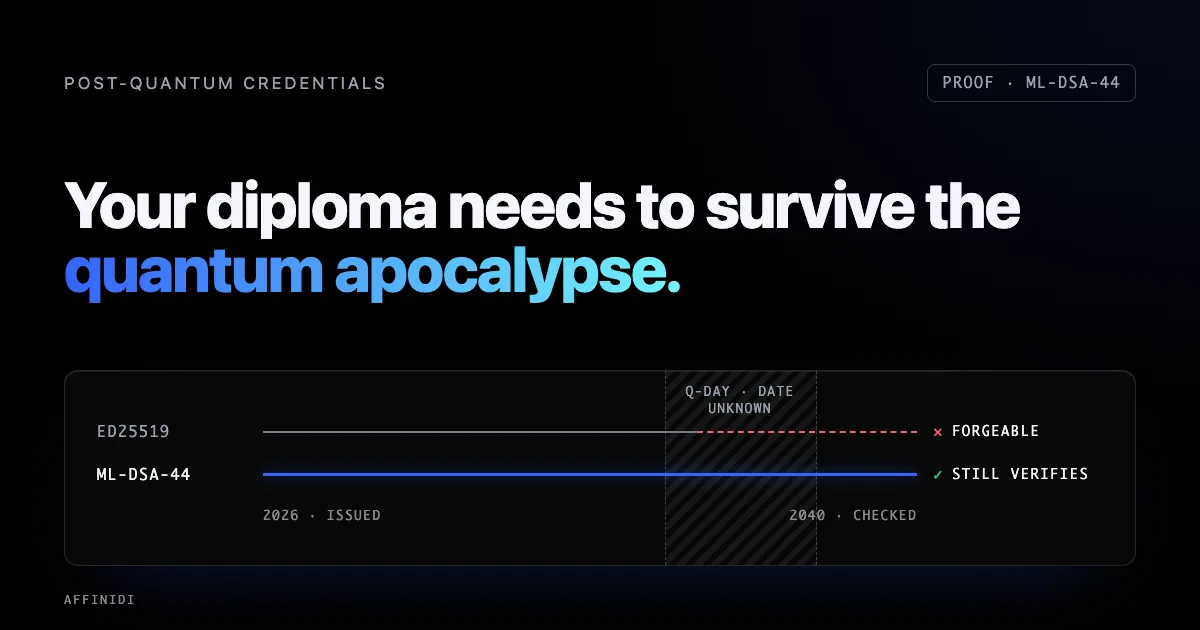
A credential issued today is verified years later. Once Q-Day lands — on a date nobody can predict — a classical Ed25519 signature becomes forgeable, while an ML-DSA-44 signature still verifies.
What we actually shipped
Given all that, we added an option: issuers can now sign verifiable credentials using ML-DSA-44, a post-quantum signature algorithm, as an alternative to the classical schemes (like Ed25519 or ECDSA) already supported.
The key word there is option. This isn’t a flag day where everyone’s forced onto new cryptography overnight. Each issuer decides, per credential or per policy, which signature suite to use. The proof type is declared right in the credential itself, so a verifier can look at that field and know exactly which algorithm to check against. Old wallets and verifiers that only understand classical signatures keep working exactly as before; nothing breaks underneath them.
The part everyone actually wants to know: how much bigger does everything get?
This is where post-quantum cryptography stops being a research topic and starts being a very concrete engineering problem. Lattice-based signatures like ML-DSA are fast, but they are big, especially compared to the elliptic-curve signatures most VC systems use today.
| Ed25519 (classical) | ML-DSA-44 | |
|---|---|---|
| Public key size | 32 bytes | 1,312 bytes |
| Signature size | 64 bytes | 2,420 bytes |
Roughly speaking, the signature alone goes from something that fits in a tweet to something closer to the size of a small image file. That difference sounds abstract until it hits three very specific, very physical places:
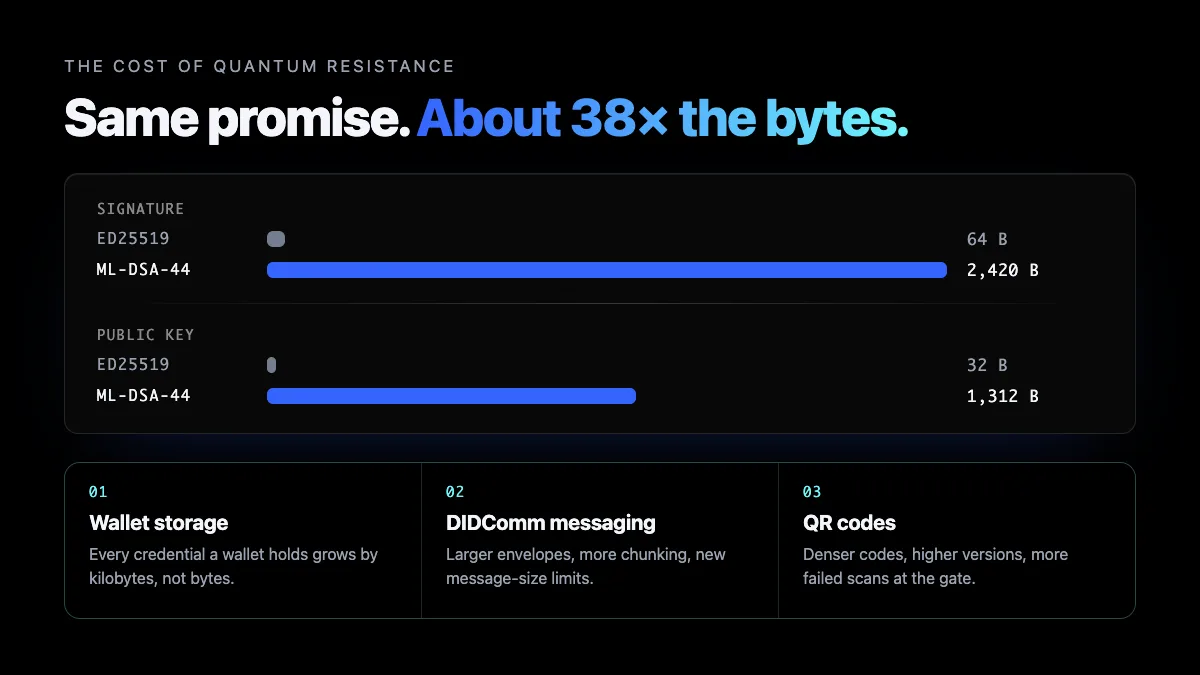
Same cryptographic promise, roughly 38× the bytes — and that extra weight lands squarely on wallet storage, DIDComm messaging, and QR codes.
Wallet storage. Digital wallets are increasingly expected to hold many credentials per person: a driver’s license, a diploma, a vaccination record, a professional certification, maybe a dozen more. When each one grows by a few kilobytes, that adds up fast, especially on lower-end devices or in regions where storage and bandwidth are still genuinely constrained.
DIDComm messaging. Credentials are often exchanged over DIDComm, a messaging protocol with its own envelope and transport assumptions. Bigger payloads mean more chunking, more compression consideration, and in some cases bumping into message size limits that nobody thought about when the transport was designed around 64-byte signatures.
QR codes. A lot of credentials get presented by scanning a QR code off a phone screen. QR codes have hard capacity limits, and denser codes need better cameras, better lighting, and more patience to scan reliably. A 40x jump in signature size can push you into a higher QR version and a lower error-correction level, which in the real world means more failed scans at the airport gate or the pharmacy counter, not just a theoretical capacity number.
None of these are reasons not to do this. They’re reasons this was an engineering project and not just a checkbox.
What we’re not solving yet
Shipping ML-DSA-44 as an option is a real step, not a finish line. A few things stay open:
- Crypto-agility in the data model itself. As new algorithms get standardized or old ones get deprecated, credentials need a clean way to express “signed with X” without breaking verifiers that only know about Y. We’ve built the first version of that, but it’ll keep evolving.
- The transition period itself. For now, most of the ecosystem still only understands classical signatures. Widespread post-quantum verification support in wallets and verifiers will take time, and issuers adopting ML-DSA-44 today are, in a real sense, betting on where the ecosystem is headed.
The takeaway
Post-quantum cryptography usually gets talked about as a future problem. For verifiable credentials, it’s closer to a present one, quietly, because the things we sign today are meant to still mean something a decade from now. Giving issuers the choice to sign with quantum-resistant algorithms now, without breaking anything that already works, felt like the right way to start closing that gap.
Your diploma might outlive the classical algorithm that signed it. Better to plan for that now than to explain it later.