Why Agent Identity is the Missing Piece in Enterprise AI Governance
As AI agents move beyond copilots to autonomous actors, identity — not models or data — becomes the foundation of trust. This article explains why verifiable agent identity matters and how Affinidi Trust Fabric enables it at scale.
The Rise of Autonomous Agents in the Enterprise
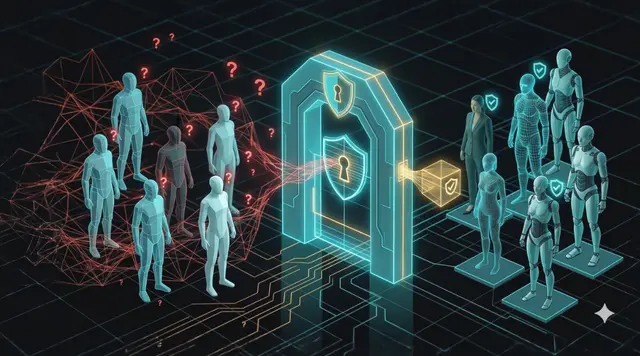
Enterprise AI is entering a new phase. What began as experimentation with models and copilots is rapidly evolving into a world of autonomous agents. These agents are no longer passive tools. They are making decisions, orchestrating workflows, interacting with customers, and even collaborating with other agents across systems. As their capabilities expand, they are becoming deeply embedded in how enterprises operate.
Why Traditional AI Governance Is No Longer Enough
Yet while the technology has advanced quickly, governance has not kept pace. Most enterprise AI governance frameworks still focus on familiar pillars such as model performance, data quality, bias mitigation, and access control. These are necessary, but they are no longer sufficient. There is a deeper, more fundamental question that remains unanswered: who, exactly, is the agent acting inside your enterprise?
This is the blind spot that is quietly becoming one of the biggest risks in enterprise AI. Unlike traditional systems, AI agents are dynamic and autonomous. They can be instantiated on demand, evolve over time, and act on behalf of different entities. Some represent employees, others represent customers, and increasingly, agents represent other agents. However, in most environments today, these agents lack a verifiable identity.
Why API Keys and Tokens Don’t Create Trust
This is where current approaches fall short. Most agents are technically authenticated, but only at the system level. An API key or access token can show that a request comes from an approved application, but it does not carry meaningful context about the agent itself, such as who issued it, what role it is performing, what permissions it should have, or whether those permissions are appropriate for a specific interaction. In other words, today’s credentials can verify access, but they do not establish accountable, portable trust.
They are typically authenticated through API keys, tokens, or system-level credentials that say little about who created them, what they are authorised to do, or whether they can be trusted in a given context. This creates a fragile foundation. If an agent cannot be reliably identified, it cannot be reliably governed. Without identity, there is no meaningful way to establish trust, and without trust, there is no clear accountability.
This is why agent identity is not just another feature to be added into the stack. It is the missing layer that everything else depends on. Agent identity enables organisations to answer critical questions in real time: where did this agent come from, who issued it, what permissions does it carry, and can it be trusted to access sensitive data or execute high-impact actions? When identity is verifiable and portable, trust becomes composable and can travel with the agent across systems and interactions.
From Access Control to Accountable Action with Agent Identity
Consider a bank using an AI agent to help process mortgage applications. The agent collects income documents, verifies employment, requests property valuations, checks fraud signals, and prepares a recommendation for a human loan officer. To do this, it must interact with multiple internal systems and external partners handling sensitive customer and financial data.
Without a verifiable identity, those systems only see software making requests through a token or API key. They cannot easily tell who issued the agent, whether it is approved for mortgage processing, or whether it should have access to that customer’s data at that stage of the workflow. If something goes wrong, accountability quickly becomes unclear.
How Affinidi Trust Fabric Enables Trusted Agent Identity
Affinidi Trust Fabric introduces a new model for addressing this challenge. It provides a foundational layer of trust for digital interactions by enabling identities to be issued, verified, and used without relying on centralised intermediaries. Built on open standards such as decentralized identifiers and verifiable credentials, Affinidi Trust Fabric allows identity to be cryptographically secure, interoperable, and independently verifiable.
Agent Identity in Practice: did:web and did:webvh
Applied to AI agents, this creates a fundamentally different approach to governance. Each agent can be assigned a decentralised identity that serves as a verifiable anchor of trust. In practice, that identity can be expressed as either did:web or did:webvh, depending on the level of assurance the use case requires. A did:web identity is simple to deploy and easy for enterprises to adopt because it builds on familiar web infrastructure, HTTPS, and existing domain trust. A did:webvh identity retains that same web-native interoperability while adding verifiable history, signed updates, and stronger tamper evidence, making it especially valuable for long-lived agents, cross-organisational workflows, and higher-assurance environments. In both cases, the identity is not just a static label, but a container for credentials that describe the agent’s origin, role, permissions, and policies. These credentials are tamper-evident and can be verified by any system the agent interacts with, without requiring prior integration or shared infrastructure.
When an agent initiates an interaction, it can present its agent card, together with verifiable credentials, as proof of who it is and what it is allowed to do. The agent card expresses the agent’s identity, capabilities, and endpoints, while the credentials provide the verifiable proof behind those claims. At the same time, communication channels are secured by design, ensuring that interactions are encrypted, authenticated, and resistant to tampering. Trust is not simply asserted; it is enforced at the protocol level.
Embedding Governance into Every Interaction
This transforms governance from something that happens after the fact into something that is embedded into every interaction. Instead of relying on centralised logs and retrospective audits, enterprises gain real-time assurance. Every action can be traced back to a verifiable identity; every access request can be evaluated based on trusted credentials, and every interaction can be governed by explicit, machine-verifiable policies.
Scaling Trust Across Organisational Boundaries
Agents will increasingly operate across organisational boundaries, interacting with partners, platforms, and external ecosystems. Traditional identity models, which rely on centralised directories and bilateral integrations, struggle to scale in this environment. Affinidi Trust Fabric enables a decentralised approach where trust can be established without requiring every participant to share the same system, making trust interoperable across ecosystems.
In a future where agents are active participants in a broader digital economy, the ability to verify not just data, but the entities acting on that data, becomes essential. The enterprises that succeed will not simply be the ones that deploy the most agents, but the ones that can trust them to operate safely, securely, and in alignment with policy.
This is where trusted agent identity becomes operational. Affinidi Trust Fabric provides the infrastructure to embed identity, trust, and consent into every interaction, closing the gap between autonomy and control.